AI visibility: what AI assistants read, and who they send you
Verified, not claimed
Checked against 8 operators' published address lists.
Signatures checked
Web Bot Auth signatures, as the ChatGPT agent sends.
Collect without code
Vercel and Netlify log drains, or POST /v1/hits from any server.
Its own allowance
10,000 to 100,000 server requests a month.
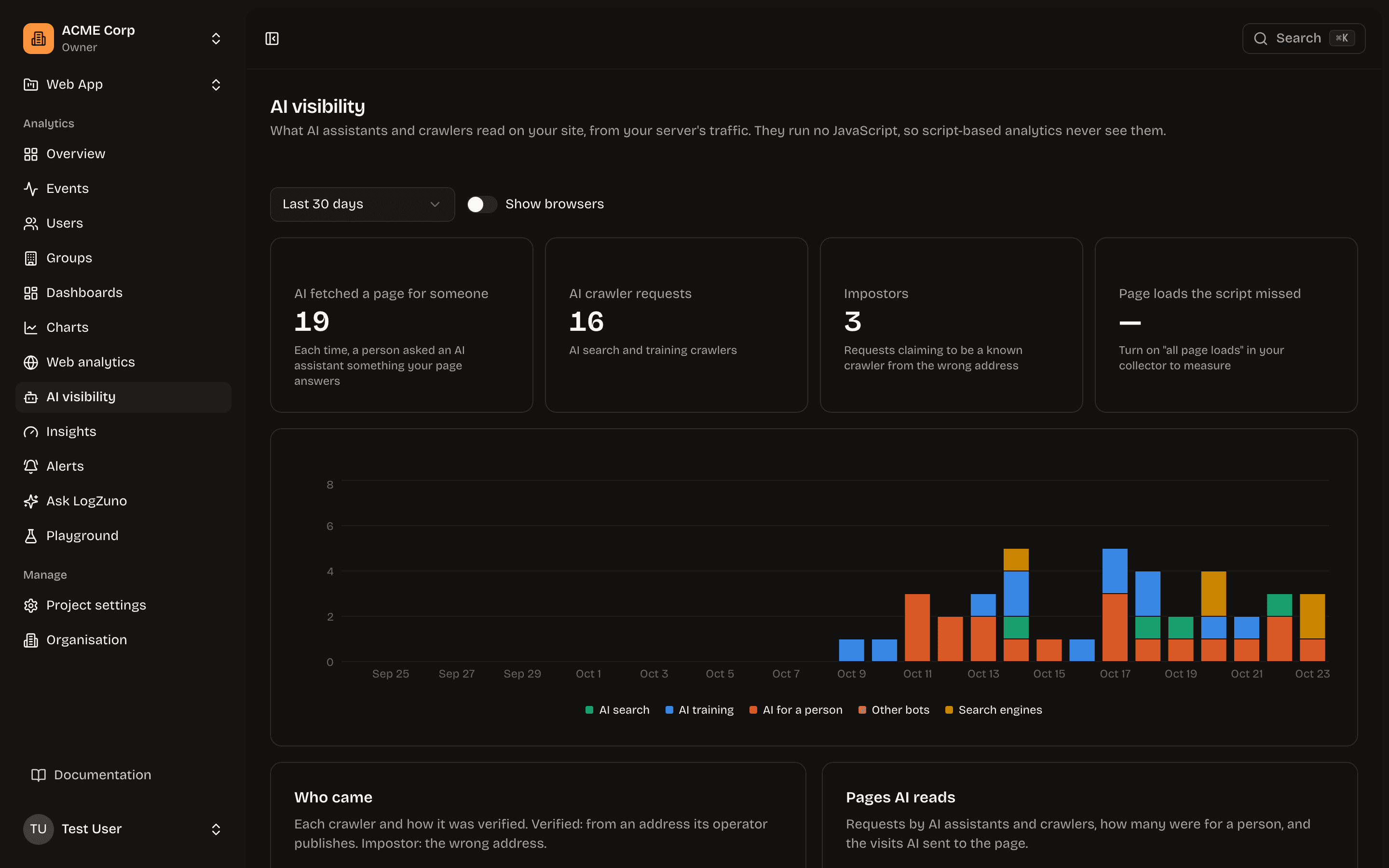
Every AI fetch, verified
Three kinds of AI traffic
Fetches made because a person asked an assistant (ChatGPT-User, Perplexity-User, Claude-User), AI search crawlers (OAI-SearchBot, PerplexityBot, Claude-SearchBot) and training crawlers (GPTBot, ClaudeBot, CCBot), kept apart.
Verified, not claimed
A request is verified when its address is in the list the operator publishes (OpenAI, Perplexity, Anthropic, Google, Microsoft, Apple, DuckDuckGo, Common Crawl), or when it carries a valid Web Bot Auth signature, as the ChatGPT agent's do.
Impostors named
A request claiming to be GPTBot from an address outside OpenAI's list is shown as an impostor, grouped by the agent it pretends to be.
Pages and errors
The pages each assistant reads most, the ones nobody arrives at from AI, the 4xx and 5xx errors served to AI fetchers, and every robots.txt, llms.txt and sitemap fetch.
Visits from AI, proven and likely
Proven
Visits with an AI assistant's referrer or UTM tag.
Likely
A visit with no referrer that lands on a page within a short window after a verified fetch of that page. The window is measured from your own tagged visits (the 95th percentile of at least 100), never guessed, and each fetch can explain only one visit.
What they did next
How many AI-referred visitors your app later identified as users, so you can see which assistant sends people who sign up.
The script gap
The share of browser page loads your server saw that never ran the analytics script.
Collect from your server or CDN
Collectors send only what script-based analytics can't see: crawlers, AI fetchers, scripts and headless browsers, plus robots.txt, llms.txt and sitemap requests.
Vercel log drain
On Vercel Pro and Enterprise: add a log drain pointed at LogZuno, with no code.
Netlify log drain
On Netlify Enterprise: the same, from your site's log drain settings.
Any server: POST /v1/hits
Send batches of up to 100 requests after you respond, from any language, with a server key.
Ready-made collectors
Cloudflare Workers, Node.js and Next.js, Laravel and WordPress collectors are built and will be listed in the docs when their packages are published.
A separate allowance
Not your event quota
Server requests have their own monthly allowance, from 10,000 to 100,000 a month depending on the plan, so a crawler storm never eats your product events.
IPs never stored
Addresses are checked against the published lists when the request arrives, then discarded.
Alerts
Get alerted when AI fetches for people drop or spike, when AI fetchers hit errors, or when an impostor appears.
In the trial
The 7-day trial includes 500 server requests.
| Plan | Events a month | Server requests a month |
|---|---|---|
| Starter | 50,000 | 10,000 |
| Growth | 100,000 | 20,000 |
| Business | 200,000 | 50,000 |
| Enterprise | 500,000 | 100,000 |
| 7-day trial | 500 | 500 |
Questions
Why doesn't Google Analytics show ChatGPT visits?
ChatGPT reads pages from OpenAI's servers without running JavaScript, so no analytics script runs. And when a person clicks a link in ChatGPT, the visit often arrives with no referrer, so it's reported as Direct.
Does LogZuno track whether ChatGPT mentions my brand?
No. LogZuno measures what actually reaches your site: which assistants fetched which pages and how many people they sent. Tracking what answers say about you is a different kind of tool.
Can I see AI visits without changing my server?
Proven AI visits (with a referrer or UTM tag) show up in web analytics with just the LogZuno script. AI fetches and likely visits need a collector, because only your server or CDN sees them.
What is AI visibility?
The term is used two ways. Some tools measure how often AI answers mention your brand. LogZuno measures what actually reaches your site: which AI assistants fetch which pages, verified against their operators' address lists, and how many people they send.
How do I track AI visibility?
To see AI fetches, send your server's requests to LogZuno: a Vercel or Netlify log drain needs no code, and any server can POST them to /v1/hits. To see visits from AI assistants, add the LogZuno script to your pages. Each part works on its own.
What is the difference between AI visibility and SEO?
SEO is about ranking in search results. AI visibility is about being read and recommended by AI assistants, which fetch pages on behalf of the people asking them. The basics overlap (fast, crawlable, clear pages), but the traffic and how you measure it differ.
How do I increase AI visibility?
Make sure your robots.txt allows the AI agents you want, serve real HTML that doesn't depend on JavaScript, fix the errors AI fetchers hit, and publish an llms.txt. LogZuno shows which pages assistants read, which fail, and whether visits follow.
Which AI assistants does LogZuno recognise?
Fetchers and crawlers from OpenAI, Perplexity, Anthropic, Google, Microsoft, Apple, DuckDuckGo and Common Crawl are verified against their published address lists. Visits from ChatGPT, Perplexity, Claude, Gemini, Copilot, Meta AI, DeepSeek, Grok and Le Chat are recognised by referrer or UTM tag.
Read next
- GuideHow to find ChatGPT traffic in GA4, and why some of it is missingHow to see ChatGPT traffic in GA4: the AI Assistant channel, the utm_source=chatgpt.com tag, why many ChatGPT clicks land in Direct and what fills the gap.Read
- GuideAI crawler user agents, what they do and how to verify themAI crawler user agents in 2026: every agent from OpenAI, Perplexity, Anthropic, Google, Apple, Amazon, Meta and Common Crawl, its job and its IP list.Read
- Free toolAI crawler checkerFree AI crawler checker: enter your site and see whether GPTBot, ChatGPT-User, PerplexityBot, ClaudeBot and 18 other crawlers may read it, per robots.txt.Read
Send your first event today.
7 days free on any plan, up to 500 events. Then from $17 a month. Cancel during the trial and you pay nothing.